
Load Balancing
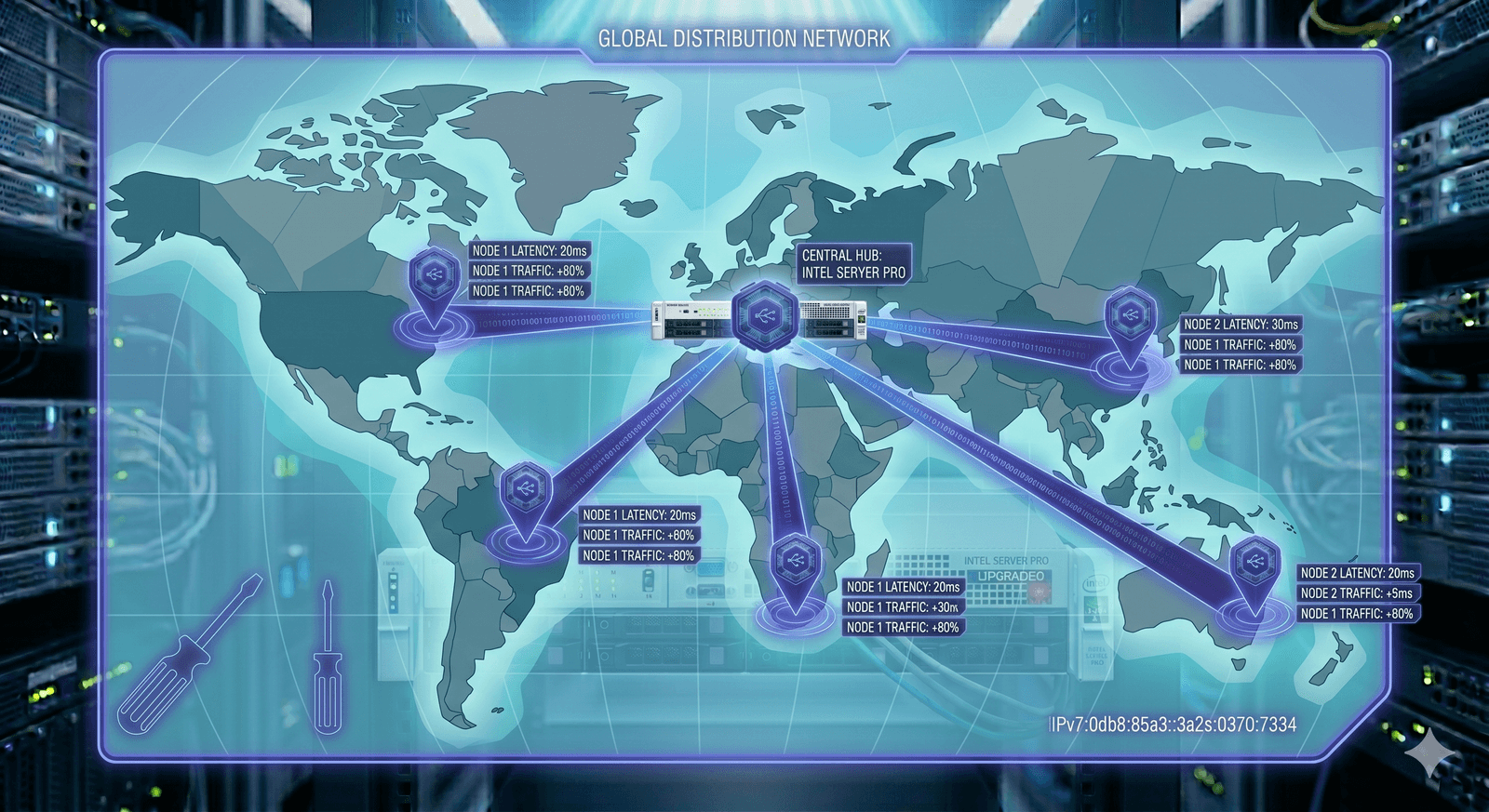
On any Server Trafficweb deployment you can add managed load balancing — distribute traffic across multiple backends for high availability, horizontal scale and zero single points of failure.
🎉 Join countless satisfied clients who trust us to power their digital ventures. Ready to experience unmatched reliability and support?
On any Server Trafficweb deployment you can add managed load balancing — distribute traffic across multiple backends for high availability, horizontal scale and zero single points of failure.
The Load Balancing add-on is the step that turns a collection of servers into a single, resilient service. Once you put a load balancer in front of two or more dedicated servers, VPS instances or cloud servers, your application stops depending on the uptime of any single machine. Deploys, reboots, hardware failures and routine maintenance happen behind the balancer — your users keep seeing a fast, available service the whole time.
A good load balancer does much more than round-robin requests. It continuously checks the health of each backend and stops sending traffic to ones that fail. It supports session stickiness when your application needs it. It distributes by least-connections when some requests are heavier than others. It terminates TLS for you, so backends do not have to manage certificates individually. And it gives you a single stable public address that lives in front of many changing backends, so DNS does not have to be touched every time the topology evolves. That combination of intelligent distribution, observability and stability is what transforms a fragile single-server setup into a serious operation.
The benefits stack up immediately. Resilience goes up: a single backend failure becomes a non-event because traffic shifts to the survivors within seconds. Scalability becomes practical: when traffic doubles, you add another backend behind the balancer and capacity doubles too. Maintenance windows disappear: deploys roll through backends one at a time without any user-visible disruption. Security gets stronger: the balancer becomes a controlled choke point where you apply rate limits, geo rules and protective filtering.
For most teams, load balancing is the upgrade that takes a side project to a serious platform. Pair this add-on with DDoS protection in front of the balancer so attacks cannot saturate the entry point, combine with a CDN to offload cacheable traffic to the edge, and add Monitoring and Reporting so you can see the health and request distribution of every backend in real time. The result is the kind of stack that absorbs surprise traffic surges, partial outages and routine deploys without breaking a sweat.
Key Benefits
A single backend failure becomes a non-event. Traffic shifts to healthy servers in seconds and users never see an error page or 502 timeout.
Add backends behind the balancer to grow capacity. Twice the traffic? Run twice the backends — the balancer takes care of distributing the load fairly.
Configurable probes test each backend continuously and remove unhealthy ones from rotation within seconds, recovering them automatically when they return to health.
Round-robin, weighted round-robin, least-connections and session-sticky modes — pick the algorithm that matches your workload, not a one-size-fits-all default.
A single stable IP/DNS in front of many changing backends means your DNS records do not have to change every time the topology evolves.
Centralise TLS termination at the balancer so backends do not have to manage certificates individually. End-to-end TLS to backends is also supported when you need it.
Roll deploys through backends one at a time with the balancer draining connections cleanly. Releases stop being scary events that need a maintenance window.
The balancer becomes a controlled choke point where rate limits, geo rules and protective filtering apply — a natural pair with DDoS protection and firewalls.
Built for real workloads
Run two or more application servers behind a balancer so deploys, restarts and hardware failures never take the public service offline.
Distribute matches, voice sessions and chat connections across multiple backends to handle large player or user populations with consistent latency.
Spread encoder and origin load across multiple streaming servers, with health checks routing around any individual server going unhealthy.
Use balancers to distribute incoming jobs across pools of worker servers without baking complex client-side discovery logic into your application.
Internal balancers in front of microservice pools give your services discovery, retries and observability without bolting on a heavy service mesh.
Simple. Predictable. Powerful.
Decide how many backends, which algorithm and which health checks. Our engineers help map balancer behaviour to the specific workload you are running.
A managed balancer is provisioned with a stable public address and your initial backend pool attached. TLS, certificates and DNS are configured during setup.
Run controlled tests to verify failover, stickiness, certificate handling and algorithm behaviour under realistic load — and adjust based on what you see.
Switch DNS to the balancer's stable address. The balancer takes over from there and starts routing live traffic across your backends.
Add or remove backends as traffic grows. Combine with Monitoring to see exactly how requests are distributed and where bottlenecks emerge.
Frequently asked questions
Detailed answers to the questions our customers ask most often about this service.
Explore other Server Trafficweb solutions that pair well with this service.
Enjoy seamless streaming with our offshore services. Unlock the secrets to uninterrupted streaming and say goodbye to buffering forever!